Clean Technology for
Coastal Livelihoods
HEAL Movement's Tech-Development program pioneered a low-cost, eco-friendly scientific kiln that transformed the hazardous, outdated seashell processing industry into a dignified, healthy, and commercially viable livelihood for coastal women in Kanyakumari District — proving that appropriate technology can be both a tool of economic empowerment and environmental protection.
Transforming a Toxic Tradition into a Sustainable Enterprise
For generations, seashell workers in Kanyakumari District have processed dead mollusk shells into calcium hydroxide (lime) powder using rudimentary open-air kilns — a process that generated toxic fumes, caused severe occupational health hazards, and produced sub-standard outputs excluded from government procurement due to lack of certification. Women and children in surrounding communities bore the greatest health burden.
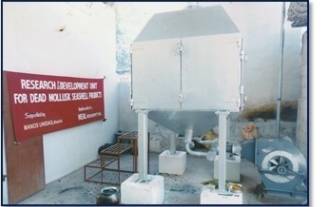
Between 2014 and 2020, HEAL Movement — in partnership with MANOS UNIDAS, Madrid, Spain — implemented the Research and Development Unit for Dead Mollusk Seashell Products project across Puthukudirupu and Rajakkamangalam Blocks in Kanyakumari District. The program combined technological innovation, enterprise development, and deep SHG capacity building to transform an entire industry.
"Technology, when designed with and for the community, does not merely improve processes — it restores dignity, health, and economic agency to the most marginalized workers."
Partnership: MANOS UNIDAS, Madrid, Spain
MANOS UNIDAS is a Spanish Catholic NGO with over six decades of experience supporting development programs across Asia, Africa, and Latin America. Their partnership with HEAL funded the 2014–2020 Research and Development Unit for Dead Mollusk Seashell Products in Kanyakumari District, covering both technological innovation and community enterprise capacity building.

A Phased, Community-Centred Innovation Pathway
The project followed a carefully sequenced six-stage implementation pathway — building community ownership, technical capability, and enterprise sustainability at every step before advancing to the next.
Group Formation
Identifying and organizing target seashell worker communities into cohesive Self-Help Groups across Puthukudirupu and Rajakkamangalam Blocks — establishing the social foundation for collective enterprise and shared resource management.
Capacity Building Training
Delivering foundational training to SHG members on financial literacy, group governance, rights awareness, enterprise management principles, and the importance of accessing government schemes and entitlements.
Construction of Work Sets
Establishing purpose-built, safe workspaces equipped with the necessary infrastructure, tools, and safety provisions for seashell processing — replacing hazardous open-air processing sites with structured production environments.
Business Management Training
Building enterprise management competencies in SHG members — covering raw material procurement, production costing, quality control, account maintenance, marketing linkages, and transparent financial governance.
R&D of Dead Mollusk Seashell Products
Systematic research and development of improved seashell processing technologies — including design, testing, and refinement of the Scientific Modern Kiln — to produce certified, market-ready calcium hydroxide products meeting government quality standards.
Low-Cost Mechanized Unit Construction
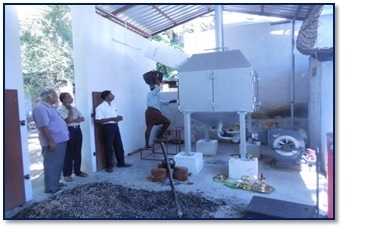
Constructing and commissioning the community-operated Low-Cost Mechanized Kiln Unit — an operator-friendly, high-throughput, smoke-free, and health-safe processing facility designed specifically for women workers.
A Toxic Industry That Punished the Most Vulnerable
The traditional seashell kiln was not merely technically outdated — it was a documented health emergency that devastated communities, excluded workers from formal markets, and trapped families in a cycle of hazardous poverty.
Traditional Kiln — Health & Market Failures
Open-air combustion generated toxic fumes and heavy smoke — contaminating village air quality and causing severe respiratory illnesses in workers and surrounding households.
Prolonged exposure disproportionately affected pregnant women — with documented links to children born with developmental delays and reduced cognitive capacity in affected communities.
Hand or power-driven blower arrangements were ergonomically inadequate — requiring intense manual labor while providing no protection from toxic gas exposure.
No government laboratory certification possible in Kanyakumari District — forcing operators to sell exclusively on informal markets at discounted prices, excluding them from lucrative Panchayat and Health Department procurement.
Outdated, low-throughput production methods resulted in poor economic returns, trapping workers in subsistence-level livelihoods despite significant labor inputs.
HEAL's Scientific Kiln — The Innovation Response
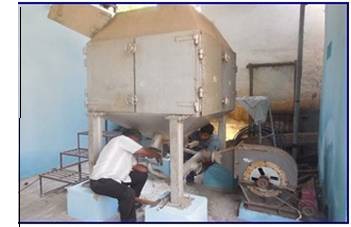
Installed a larger, high-efficiency fan on the Scientific Modern Kiln — resolving combustion problems, ensuring complete fuel burning, and eliminating toxic gas emissions from the processing environment.
Designed a dedicated smoke pipe extraction system that channels all combustion gases safely away from the work area — creating a clean, healthy indoor working environment for women operators.
The Low-Cost Mechanized Kiln processes significantly higher volumes of seashell per slot — improving productivity, reducing unit production costs, and increasing income per unit of labor invested.
Specifically designed as a women-friendly unit — with ergonomic controls, safe operating procedures, and workspace design that accommodates women's physical capabilities and safety needs.
Designed and constructed at significantly lower capital cost than industrial alternatives — ensuring replicability for small-scale community enterprises without dependence on large external investment.
From Hazard to Innovation — Side by Side
The contrast between the traditional open kiln and HEAL's Low-Cost Mechanized Kiln illustrates just how transformative appropriate technology can be when designed with community health and livelihood needs at its core.
Traditional Open Kiln
Pre-2014 · Conventional MethodLow-Cost Mechanized Kiln
Post-2014 · HEAL InnovationFive Design Principles Behind the Innovation
The Low-Cost Mechanized Kiln was engineered through rigorous assessment of five critical design parameters — ensuring the technology was sustainable, accessible, and genuinely community-owned.
Scientific Assessment
Systematic evaluation of the kiln's technical performance under field conditions — validating combustion efficiency, emission levels, and product quality against scientific benchmarks.
Cost-Benefit Analysis
Rigorous analysis of time, electricity consumption, charcoal-to-output ratio, and labor costs — ensuring the kiln delivers economically viable returns for small-scale community enterprises.
Optimized Manpower Use
Designed to require minimal specialized labor — enabling unskilled community women to operate, maintain, and manage the unit confidently after short training periods.
Women-Friendly Design
Every aspect — from control height to batch weight to operational cycle time — was designed with women's ergonomics, safety, and comfort as primary engineering considerations.
Replicable Low-Cost Design
Intentionally engineered at a fraction of industrial kiln costs — using locally available materials and simple construction techniques to ensure community groups can replicate the unit independently.
Three Market-Grade Calcium Hydroxide Products
The scientific kiln produces three distinct grades of calcium hydroxide (lime) powder — each serving a different market segment and collectively enabling diversified, stable revenue streams for the women-operated enterprise.
Whitewashing Lime
High-purity calcium hydroxide used for interior and exterior house whitewashing — the premium-grade product with the highest market demand and price point among domestic and small business buyers.
Construction Mortar Lime
Medium-grade calcium hydroxide used as an ingredient in building construction mortar and plaster — serving the construction industry as a reliable, cost-effective binding and finishing agent.
Agricultural Insecticide & Sanitation Agent
Widely used as an eco-friendly insecticide in agriculture and as a sanitation cleaning agent by local Panchayats — government-procured in large quantities when certified by authorized laboratories.
The Certification Challenge — Now Being Addressed
Traditional operators had been unable to sell to Health Departments and Panchayats because Kanyakumari District lacked a government-accredited certification laboratory — forcing all testing through the facility in Thoothukudi. HEAL's advocacy and the improved product quality from the scientific kiln have created the conditions for certification, opening up lucrative institutional procurement channels previously inaccessible to seashell workers.
Building 60 Self-Help Groups — From Dependent to Independent
Beyond the technology, HEAL invested deeply in the human and institutional capacity of 60 SHGs — designing differentiated training programs based on each group's readiness level and systematically advancing their capabilities across ten rounds of deep-level capacity building training.
Independent Groups
Fully self-governing SHGs managing their own meetings, accounts, petitions, and government scheme applications without HEAL staff facilitation.
Semi-Independent Groups
Progressing SHGs demonstrating growing autonomy in most functions but requiring periodic guidance in financial management or government engagement.
Groups in Development
Newer or more challenging groups receiving focused capacity support to build foundations for eventual full independence.

Ten deep-level training rounds were delivered across the 60 SHGs — each session targeted to the specific developmental needs of the group category. The curriculum covered a comprehensive range of enterprise, rights, and social development topics:
-
Financial Governance: Proper maintenance of registers, books of accounts, and transparent record-keeping systems to build SHG credibility with banks and government departments.
-
Financial Access: Navigating bank loans, revolving funds, direct loans, and government financial assistance — with practical guidance on application submission and follow-up.
-
Women's Rights & Laws: Understanding legal protections, constitutional entitlements, and the Right to Information Act — building women's confidence to assert their rights independently.
-
Civic Participation: Benefits of attending Grama Sabha, Panchayat meetings, and Federation assemblies — training members to advocate for their community's interests in formal governance forums.
-
Income Generation & Marketing: Economic development strategies, market linkage identification, product marketing, pricing, and creating sustainable income diversification pathways.
-
Health, Sanitation & Education: Building awareness of health entitlements, sanitation practices, and the transformative importance of children's education for long-term family prosperity.
-
Petition Writing & Government Navigation: Practical skills in drafting and submitting petitions to government departments — with guidance on which departments to approach and how to follow up effectively.
-
Federation Strengthening: Understanding the importance of federation-level participation for collective bargaining, shared advocacy, and institutional resilience beyond the individual SHG.
Transformative Change Across 60 SHGs
The combined effect of the technology innovation and SHG capacity building program produced measurable, verifiable behavioral, institutional, and economic changes across all 60 Self-Help Groups in the project area.
Independent Government Engagement
Women now independently navigate government departments to submit petitions and applications — replacing the earlier dependency on HEAL staff escorts for every official interaction.
Weekly Meetings — Revolving Fund Eligibility
SHGs upgraded from monthly to weekly meetings — meeting the eligibility threshold for government-linked revolving funds and accelerating their access to formal financial support.
350 Fishermen Welfare Board Enrollments
350 SHG members submitted applications to enroll in the Tamil Nadu Fishermen Welfare Board — securing access to occupational welfare benefits previously unclaimed due to lack of awareness and support.
Increased Savings Discipline
Regular savings practices have significantly increased across member households — building financial buffers, improving creditworthiness, and reducing vulnerability to income shocks.
Growing Women's Participation
Interest in joining SHGs has grown substantially as word spread about the program's benefits — demonstrating community confidence in the model and creating momentum for further expansion.
Increased Training Attendance
More and more women are proactively attending training programs — a reversal from initial hesitancy — reflecting growing confidence, awareness of benefits, and peer encouragement within SHG networks.
Federation & CAC Participation
Member participation in federation activities and Child Activity Center programs has increased significantly — building intergenerational community cohesion and expanding collective advocacy capacity.
Proper Financial Record-Keeping
Members now maintain systematic accounts and registers independently — a foundational capability that enables SHGs to access bank loans, government schemes, and institutional partnerships.
What Changed — Permanently and Measurably
The six-year program produced a set of concrete, lasting outcomes that transformed both the technological infrastructure and the human capability of the seashell worker community in Kanyakumari District.
Fully Functional Scientific Kiln
The rectified Scientific Modern Kiln operates reliably as both a training demonstration unit and a production facility — serving as the community's R&D anchor for ongoing seashell processing improvements.
Low-Cost Mechanized Unit Operational
The community-operated Low-Cost Mechanized Kiln processes higher volumes per slot, is operator-friendly, hygienic, and environment-friendly — a permanent production asset owned and managed by the community.
Regular Employment for 20+ Women
The new kiln provides regular, dignified wage employment for women across the full production cycle: shell collection, cleaning, processing, and finished product marketing — without external dependency.
Zero Occupational Health Hazards
The smoke pipe system has completely eliminated toxic fume exposure — delivering a healthy working environment that protects pregnant women and surrounding families from occupational pollution.
Community Health & Environment Restored
Families living near the production unit have unanimously expressed appreciation for HEAL's intervention — the reduction in local air pollution has visibly improved community health and environmental quality.
Women's Enterprise Autonomy Achieved
Women operators have gained comprehensive skills in processing, production management, and product marketing — operating the entire enterprise independently without any external assistance.
Transparent Financial Governance
Detailed accounts of raw material procurement, wage payments, and profit distribution are maintained and periodically verified by HEAL — ensuring complete transparency in fund and resource management.
Diversified Market Linkages Established
Effective marketing connections established with shops, business enterprises, individual buyers, and government departments — creating a steady, diversified revenue stream and reducing market volatility risk.
Innovation Meets Community
Glimpses of HEAL Movement's Tech-Development program transforming seashell processing in Kanyakumari District.


Help Scale Clean Technology for Coastal Communities
Your support funds kiln replication, SHG enterprise training, quality certification advocacy, and marketing linkage development — expanding dignified, pollution-free livelihoods to more seashell worker families across Tamil Nadu's coastline.
Related Programs